
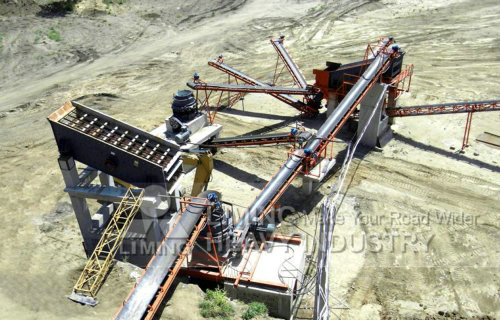
How to Extend Blow Bar Life in Impact Crusher for Dolomite 80 TPH
Mexico's Dolomite Processors Are Running Harder Than Ever
Mexico's construction sector is not pausing. The government's infrastructure programme includes more than 40 highway projects, and private investment in industrial parks along the northern border continues to expand. Dolomite, a calcium-magnesium carbonate mineral, feeds into that growth through multiple channels: as aggregate for concrete, as a flux agent in steelmaking, and as a raw material for glass and refractory manufacturing. Mexico produces substantial dolomite volumes, with production recorded across multiple states. For an operator running a 80 TPH impact crusher, that demand is welcome, but it comes with a cost centre that deserves attention: blow bars. In dolomite service, blow bars are the most frequently replaced component, and the way they are specified, installed, and monitored determines whether the crusher operates profitably or becomes a maintenance liability.
Dolomite Is Soft, But It Is Not Gentle
Dolomite sits at 3.5 to 4 on the Mohs scale, which places it in the medium-hardness category. It is not abrasive in the same way as granite or basalt, where quartz content grinds through steel at a punishing rate. But dolomite has its own wear mechanisms. The crystalline structure, when crushed, produces angular fragments that scrape the blow bar surface. Silica content, which varies by deposit, adds abrasion. And moisture, particularly during Mexico's rainy season from June to October, causes material to stick and pack, which changes the impact angle and concentrates wear on specific sections of the bar. The practical consequence is that blow bar life in dolomite service varies widely — from as little as 200 hours to over 800 hours — depending on how the crusher is set up and operated.
Blow Bar Metallurgy: Match the Grade to the Job
The first decision is material selection, and it is one that many operators get wrong by defaulting to whatever grade was installed when the crusher was delivered. For dolomite, three grades are commonly available. Martensitic steel is the baseline option: tough, resistant to cracking, and adequate for low-silica dolomite. It is the least expensive per set. Medium chrome (around 12–18% chromium) sits in the middle, offering better abrasion resistance than martensitic while retaining reasonable toughness. It suits dolomite with moderate silica content. High chrome (Cr26 or equivalent) is the premium option, with hardness in the 58–62 HRC range, and it resists abrasive wear substantially better than the lower grades. It is also more brittle, which means it can crack if the feed contains uncrushable material. The rule of thumb for dolomite is straightforward: if your deposit is low in silica and the feed is clean, martensitic or medium chrome will deliver the lowest cost per tonne. If silica content is elevated or the feed contains occasional hard inclusions, high chrome pays for itself. There is no universal answer. The right grade depends on the specific deposit.
The Operational Habits That Add Hundreds of Hours
Metallurgy sets the ceiling. Operation determines whether you reach it. Three factors influence blow bar life more than any others. Rotor speed is the first. Running the rotor faster than necessary increases impact energy and accelerates wear. The target is the lowest speed that still achieves the required product gradation. Many operators run faster than they need to because they have not tested lower speeds against their product specification. Feed size distribution is the second. An impact crusher performs best when the feed is well-graded and free of excessive fines. When fines bypass the rotor and pack against the blow bars, they create a cushioning effect that reduces crushing efficiency and changes the wear pattern. A pre-screen ahead of the crusher removes fines before they enter the chamber and extends blow bar life by reducing the volume of material the bars actually have to break. Feed rate consistency is the third. Surging feed causes the rotor to slow and then accelerate repeatedly, which stresses the blow bars and the rotor assembly. A variable-frequency drive on the feeder allows the operator to maintain a steady amp draw, which keeps the crushing action uniform and the wear pattern even.
Rotation and Inspection: The Discipline That Pays
Blow bars do not wear evenly. The leading edge takes the brunt of the impact, while the trailing edge wears more slowly. Most modern impact crushers are designed with reversible blow bars, which can be flipped to present a fresh wear surface before replacement is required. The operators who get the longest life out of their bars are the ones who inspect and rotate on a schedule. A weekly visual check and a monthly wear measurement with a depth gauge take less than an hour and provide the data needed to plan rotation. When a bar reaches roughly 30% wear, it should be rotated. When the wear pattern becomes uneven across the set — one bar noticeably thinner than its neighbours — the rotor is likely out of balance, and the cause should be investigated before installing new bars. Installing a new set on a rotor with an unresolved balance problem simply destroys the new set faster.
The Cost Per Tonne Calculation
The purchase price of a blow bar set is a poor measure of its cost. A set of high-chrome bars might cost twice as much as martensitic bars, but if they last three times as long, the cost per tonne is lower. The calculation that matters is total cost of ownership: bar cost, plus downtime, plus labour, plus the production lost during the change. For an 80 TPH dolomite operation running two shifts, a blow bar change that takes four hours represents roughly 640 tonnes of lost production. If that change happens six times a year instead of four, the production loss alone outweighs the price difference between bar grades. Operators who track cost per tonne rather than price per set consistently end up making different purchasing decisions than those who do not.
How OCP Mechanical Company Supports Mexican Dolomite Operations
OCP Mechanical Company has manufactured mining and processing equipment for over 40 years. We supply impact crusher blow bars in martensitic, medium chrome, and high chrome grades, along with jaw plates, cone liners, screen panels, and the full range of wear parts for crushing circuits. For an 80 TPH dolomite operation in Mexico, our engineering team can review your feed characteristics and recommend a blow bar grade that matches your specific deposit rather than defaulting to a standard specification. Because we sell direct from our factory, there is no distributor margin in the price, and our technical team works with you on the specification rather than handing over a catalogue. Our online customer service team is available 24 hours a day to discuss blow bar selection, provide updated pricing, and help you plan a rotation schedule that fits your production calendar. If you are managing an impact crusher in Mexico and want to reduce your cost per tonne, click the chat button and start the conversation.
-
150 TPH Mobile Cone Crusher Rental Cost in Iloilo Philippines
-
130 TPH Graphite Ore Jaw Crusher Selection Guide in Sri Lanka
-
200 TPH Complete Crushing Plant for Granite in Ibadan Nigeria
-
How to Automate a 250 TPH Sand Making Line with VSI in Saudi Arabia
-
80 TPH Barite Jaw Crusher Quotation for Mining in Morocco: What Actually Drives the Price



