
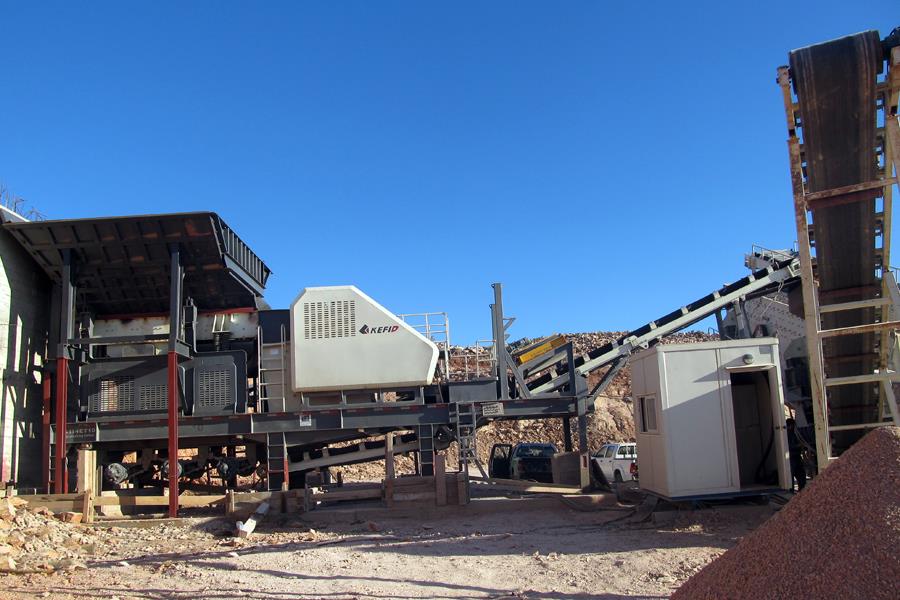
200 TPH Complete Crushing Plant for Granite in Ibadan Nigeria
Ibadan's Road Programme Is Creating a Granite Supply Gap
Oyo State is not waiting for federal road contracts to trickle down. In August 2026, President Tinubu flagged off the dualisation of the 56.5-kilometre Ibadan–Ijebu Ode Road, a N296 billion project awarded to JRB Construction Limited and scheduled for completion in June 2029. The Ido–Eruwa Road, a 48-kilometre link between the Ibadan and Ibarapa zones, is under reconstruction by Kopek Construction. These projects sit alongside private estate development across the Ibadan corridor and the steady demand from block moulders and concrete batching plants that serve the city's construction market.
All of it consumes granite. A 200 TPH crushing plant positioned in the Ibadan quarry belt has a straightforward commercial case: the raw material is local, the market is within a two-hour haul, and the product mix that Ibadan buyers want is well understood.
What Ibadan's Granite Actually Is
The Ibadan granite belt is not a uniform deposit. A study of Ratcon and NSCE quarries in Oyo State measured uniaxial compressive strength of 200 MPa at Ratcon and 240 MPa at NSCE, with average densities of 2.63 g/cm³ and 2.55 g/cm³ respectively. These are hard rocks by any standard. They also tell you something practical: a 200 TPH circuit for this material cannot be designed around soft-rock assumptions.
Granite at this hardness punishes impact crushers. Blow bars in an impact crusher running on 200–240 MPa granite will wear out fast enough that the parts bill becomes a line item that competes with profit. The industry-standard answer for this class of material is a three-stage compression circuit: jaw crusher for primary reduction, cone crusher for secondary work, and a VSI only if manufactured sand is part of the product plan.
The feed size matters just as much. Run-of-mine granite from Ibadan operations can arrive in blocks that challenge mid-sized jaw crushers. A plant designed for a 60-inch (approximately 1,500 mm) top size needs a jaw with an ultra-deep crushing cavity and a feed opening large enough to swallow that block without bridging. The C6X series jaw crusher, for example, is built for this specific problem, with a V-shaped cavity that accepts oversized feed and a heavy-duty moving jaw assembly that maintains stability under continuous impact load.
What a 200 TPH Granite Circuit Actually Contains
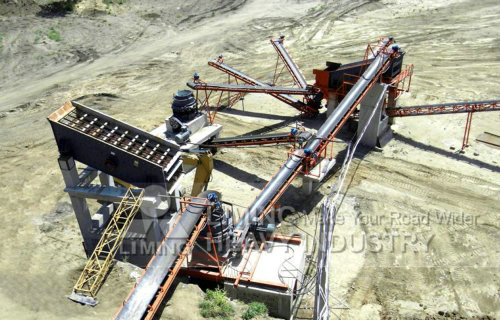
A working 200 TPH line is a chain, and every link has to match the others. The configuration that suits Ibadan granite typically runs:
Vibrating grizzly feeder — sized to accept direct truck dump, with a grizzly section that removes fines before they enter the crusher. This is not a convenience feature. It protects the jaw from packing and stabilises the feed rate.
Primary jaw crusher — a C6X-series or equivalent unit with a feed opening in the 1,100×1,200 mm class, capable of accepting run-of-mine blocks up to 1,000 mm and delivering a product in the 150–200 mm range.
Secondary cone crusher — a multi-cylinder hydraulic unit with the cavity selected to match the jaw output and the target product gradation. For granite at 200 MPa, a medium cavity running in closed circuit with a screen is the usual arrangement.
Vibrating screens — typically two or three units, classifying into 0–5 mm, 5–10 mm, 10–20 mm, and 20–30 mm fractions. The screen configuration determines whether the plant produces four saleable products or one blended pile.
Belt conveyors — sized to the full 200 TPH flow, with transfer points designed to minimise spillage and dust.
Control system — PLC-based, with the option to add remote monitoring. In a market where skilled operators are not always available, automated start-stop and fault diagnosis reduce the learning curve.
If manufactured sand is part of the product mix — and in Ibadan, the demand for plaster sand and block-making sand is steady — a VSI crusher and a sand washing unit are added after the secondary stage.
What This Plant Costs in the Nigerian Market
Equipment pricing for a 200 TPH granite crushing plant varies with configuration, but the ranges are reasonably predictable. The table below gives indicative figures for the main components.
| Component | Indicative Price (USD) | Notes |
|---|---|---|
| Vibrating grizzly feeder | 20,000 – 45,000 | Heavy-duty bars, variable speed |
| Primary jaw crusher | 65,000 – 140,000 | C6X-class, 1,100×1,200 mm feed opening |
| Secondary cone crusher | 70,000 – 160,000 | Multi-cylinder hydraulic, medium cavity |
| Vibrating screens (2–3 units) | 45,000 – 95,000 | Triple-deck, polyurethane panels |
| Belt conveyor system | 40,000 – 80,000 | Full flow, dust-suppressed transfer points |
| Control and monitoring panel | 15,000 – 35,000 | PLC-based, optional remote access |
| Dust suppression system | 15,000 – 35,000 | Spray bars, enclosed chutes |
| Installation and commissioning | 20,000 – 45,000 | Engineer supervision, operator training |
Reference pricing only. Actual quotations depend on final configuration, shipping terms, and optional features. Please confirm current pricing with our online customer service.
A complete plant with the configuration above typically lands in the USD 280,000 to USD 550,000 range, depending on the level of automation, the wear part specification, and whether a VSI and sand washing unit are included. These are equipment costs only. Freight to Lagos or Tin Can Island Port, inland transport to Ibadan, foundations, and electrical infrastructure add a further layer that should be budgeted before the purchase order is signed.
The Import Duty Question: What Actually Applies
Nigeria's federal government has been actively courting mining investment, and equipment imports sit at the centre of that pitch. At the Resources Future exhibition in London in December 2025, the Minister of Solid Minerals Development announced duty waivers on imported mining machinery and seamless profit repatriation for investors in the solid minerals sector. The policy intent is to reduce the capital barrier for operators entering the sector.
The practical reality is more nuanced. Nigeria's ECOWAS Common External Tariff (CET) places industrial machinery in the 0% to 5% duty band, with some capital goods qualifying for duty-free treatment under specific conditions. Value-added tax applies at 7.5% on most imports, and there are additional levies — a 4% FOB charge, a 7% surcharge, and a 0.5% ECOWAS Trade Liberalisation Scheme levy — that stack onto the landed cost. The duty waiver programme exists, but the exemption process requires an approved industrial licence and documentation that confirms the equipment is for mining or mineral processing use, not resale.
For an Ibadan granite project, the practical approach is to confirm the HS code classification before ordering and to prepare the documentation that the Nigeria Customs Service requires for the exemption. Working with a supplier who has experience with Nigerian imports reduces the back-and-forth that delays clearance.
The Market Context: Granite Prices and Demand Drivers
Granite prices in Nigeria have moved upward through 2026. The current quarry price for 3/4-inch granite in Ibadan sits in the ₦7,000 to ₦8,500 per tonne range, with 1/2-inch granite at ₦6,500 to ₦8,500 and stone base at ₦5,000 to ₦7,000 per tonne. Transport cost is the variable that decides the final delivered price. In September 2026, a 30-tonne truckload of granite was selling for as much as ₦860,000 in some markets, up from ₦430,000 a year earlier, with dealers citing road conditions and logistics as the primary drivers.
That price movement has two implications for a plant owner. First, it confirms that granite aggregate is a seller's market in the southwest. Second, it explains why positioning the plant close to the quarry belt matters: every kilometre saved on haulage is margin that stays in the operation. The HOY QUARRY at Ikiji, Ibadan, launched in 2025, was established explicitly to reduce material delivery time to Ibadan, Lagos, and surrounding cities while supplying the growing demand for quality building materials. That is the same logic a 200 TPH plant in the Ibadan belt would follow.
Wear Parts: Where the Operating Cost Actually Sits
In granite at 200–240 MPa, the jaw plates and cone liners are the components that determine whether the plant runs profitably. A jaw crusher running Mn18Cr2 plates at full load will wear through a set faster in Ibadan granite than in limestone. The relevant calculation is not the price per set but the cost per tonne crushed, which includes the downtime for the change, the labour, and the production lost while the crusher is stopped.
Cone crushers in this service should be specified with liners that match the cavity and the feed characteristics. A mantle and bowl liner that wear evenly maintain the closed side setting and produce consistent product gradation. A set that wears unevenly — often because of feed segregation or a cavity that is too coarse — changes the discharge profile and increases recirculating load. The operators who get the longest life out of their wear parts are the ones who inspect on a schedule, measure wear depth rather than eyeballing it, and rotate or replace before the profile distorts.
How OCP Mechanical Company Approaches Ibadan Granite Projects
OCP Mechanical Company has manufactured mining and crushing equipment for over 40 years. We build jaw crushers, cone crushers, impact crushers, VSI sand making machines, vibrating screens, feeders, sand washers, and complete crushing plants. Every machine is new. For a 200 TPH granite plant in Ibadan, our engineering team can review your feed size distribution, the ore's compressive strength, and your target product mix, and configure the circuit around those variables rather than a catalogue template.
Because we sell direct from our factory, there is no distributor margin in the price. Our technical team works with you on the layout, the equipment selection, and the wear part specification. And we can supply the technical documentation that Nigerian customs and the Ministry of Solid Minerals expect to see for equipment import exemption applications.
Our online customer service team is available 24 hours a day to discuss specifications, provide updated pricing, and help you work out which configuration suits your site. If you are evaluating a granite crushing project in Ibadan, click the chat button and start the conversation.
-
How to Automate a 250 TPH Sand Making Line with VSI in Saudi Arabia
-
80 TPH Barite Jaw Crusher Quotation for Mining in Morocco: What Actually Drives the Price
-
Which Cone Crusher Cavity Is Best for Manganese Ore 160 TPH in South Africa
-
-
How to Reduce Energy Consumption of VSI for Granite 200 TPH in Brazil



