
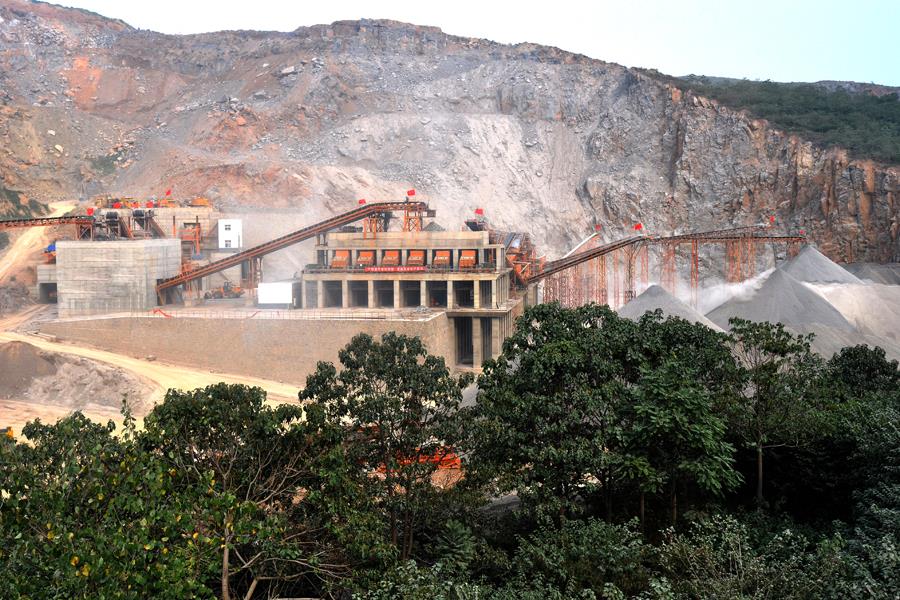
Is the vertical composite crusher effective for limestone sand production, cement raw material, and clinker crushing
The vertical composite crusher is a new fine crushing and coarse grinding product developed by our company through comprehensive integration of similar crusher technologies and optimization based on years of practical experience. This series is extensively used for crushing raw materials and clinker in cement production. It serves as an ideal fine crushing solution for cement plants undergoing technological upgrades, enabling “more crushing, less grinding” to achieve energy savings and reduced consumption. It is also suitable for fine crushing of various solvent raw materials in the steel and metallurgical industries, as well as for processing medium-hard rock minerals in construction, building materials, chemical, and other sectors.
Before exploring the compound crusher, let's briefly outline its working principle. During operation, the rotor fixed on the main shaft rotates at high speed in a specific direction driven by the motor. Lumpy materials fall from the feed hopper onto the discharge disc. After being impacted by the high-speed rotating ribs of the discharge disc, they are rapidly thrown toward the impact plate under centrifugal force, causing collisions. Guided by the inclined surface of the impact plate and gravity, the material rebounds diagonally downward into the conical rotor crushing chamber. Here, it encounters high-speed rotating upper hammers, gaining sufficient kinetic energy before being hurled back toward the impact plate. This crushing cycle repeats, with the material mass colliding within the chamber for further fragmentation while spiraling downward through the conical space.
The material enters the cylindrical rotor chamber, where the already crushed particles undergo further fine crushing, compression, and grinding, repeating the crushing process. This high-frequency impact, counter-impact, compression, and grinding by the upper, middle, and lower hammers and impact plates progressively reduces the material size. Impact from hammers and impact plates within the crushing chamber, combined with mutual collisions between particles, causes the material to fracture along its natural cleavage planes and bedding planes. When the crushed material becomes smaller than the discharge gap of the upper rotor, it enters the middle rotor crushing chamber for fine crushing. Subsequently, the material enters the lower rotor crushing chamber, where it undergoes the aforementioned impact, counter-impact, compression, and grinding process once more. The key difference lies in the lower rotor's hammer heads operating at a higher peripheral speed than the second stage, subjecting the material to greater impact force and tighter clearance. This enables finer crushing, ultimately reducing the material to the required particle size before discharge from the machine.
In terms of crushing performance: The vertical compound crusher achieves a high crushing ratio, making it fully capable of processing limestone. The discharge particle size can be freely adjusted without being affected by wear on the impact hammers or liners. Optional water-cooled chassis, high-temperature resistant bearings, and high-temperature grease rated above 260°C enable crushing of high-temperature materials (material temperature below 150°C).
Regarding equipment structure: The vertical compound crusher features a uniquely designed rotor body that forms a multi-stage continuous crushing chamber. This maximizes energy and space utilization, enhancing machine performance. The material-ejecting ribs and ejector liners are arranged in a circular cross pattern. Worn ribs can be repurposed as ejector liners, improving material utilization and reducing operating costs.
In terms of crushing efficiency: The crushed limestone produced by the vertical composite crusher can be used for grinding raw materials and clinker in cement plants. It is also suitable for fine crushing of various solvent raw materials in the steel metallurgy industry, as well as crushing various medium-hard rock minerals in construction, building materials, chemical, and other fields. Its wide range of applications meets diverse production needs.
From an environmental and energy-saving perspective: Utilizing high-hardness, high-toughness multi-alloy wear-resistant hammers and liners ensures superior resistance to abrasion and impact, extending service life. The equipment features excellent sealing performance, minimal dust generation, low noise levels, stable operation, and convenient operation and maintenance.
With over 40 years of expertise in crusher equipment R&D and manufacturing, OCP Heavy Industry provides one-stop solutions for equipment selection, configuration, and production line process design. We welcome your online inquiries, where dedicated technical staff will provide thorough answers. You are also invited to visit our factory for consultation or tour actual production line sites!
-
What principles should a well-designed sand production line process follow
-
Which crusher is best suited for crushing and sand-making of diabase
-
What are the advantages of composite crushers as fine crushing equipment
-
Comprehensive Guide to Eco-Friendly Sand Production Line Equipment Configuration
-
Does sandstone meet construction sand standards? What crushing and sand-making equipment is best?