
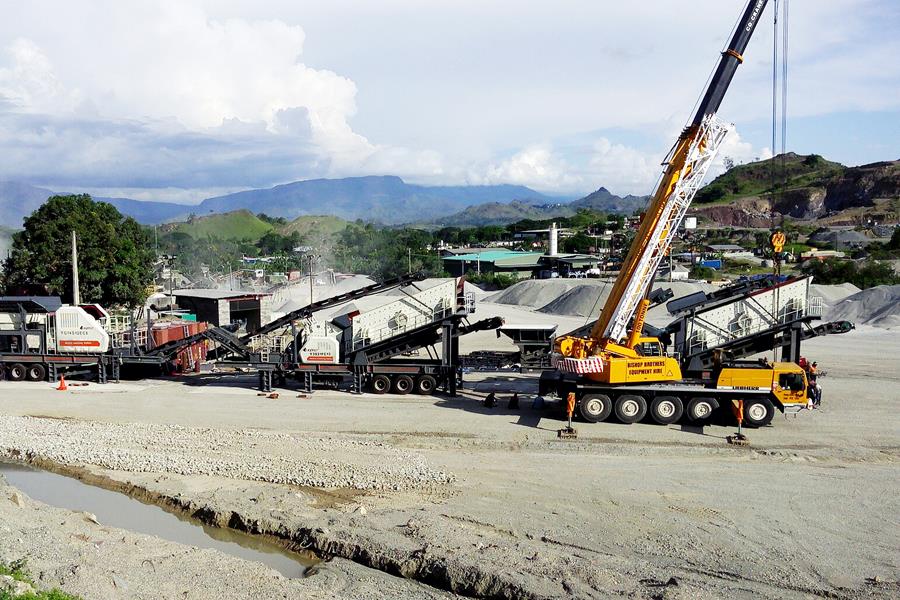
How does the performance of an impact crusher affect product particle shape
Impact crushers are primarily used for secondary crushing in production lines. Featuring a spacious feed opening, large feed size capacity, and heavy-duty rotor structure, they deliver higher crushing efficiency, greater output, lower energy consumption, simplified operation, and easy maintenance—qualities that have earned consistent customer acclaim. Their most notable feature is the excellent particle shape and stable gradation of the crushed material—key factors determining whether sand and gravel can be sold at favorable prices. To produce sand with superior particle shape, one must first understand the factors influencing particle shape and their effects.
The impact crusher features a simple structure, primarily comprising a frame, transmission mechanism, rotor, impact plates, and counter plates. Its specific performance characteristics include:
(1) The rotor generates rotational inertial impact force during crushing. Therefore, the hammers and rotor must be rigidly connected, and the rotor must possess sufficient mass.
(2) The impact plates and hammers serve as the direct force-bearing surfaces during crushing, often subjected to immense impact forces from the rotor. Consequently, they are typically fabricated from high-manganese steel or other wear-resistant materials.
Impact Crusher
Impact of inherent properties on product particle size:
(1) Impact velocity
The impact velocity of an impact crusher corresponds to the rotor speed, significantly influencing product particle size, production capacity, and plate hammer wear.
Generally, increasing impact velocity intensifies the impact force of the plate hammers, the counterforce of the impact plates, and the collision force between materials, resulting in finer product particle size. Currently, typical impact speeds range from 15 to 45 m/s. For coarse crushing, a lower impact speed should be selected; conversely, a higher impact speed is preferred for fine crushing. Additionally, when crushing harder ores, the rotor speed should be appropriately increased.
(2) Discharge Gap
The discharge gap refers to the minimum clearance between the impact plate and the impact plate hammer. It is generally accepted that the maximum product size of an impact crusher is determined by this gap dimension. This is because materials crushed by impact crushers typically form cubic shapes. When the impact force is sufficient, entering materials are thoroughly crushed, with few large fragments escaping through the discharge opening. However, when the hammer plate wear is severe—exceeding 60% to 70%—the situation changes. At this stage, the impact force at the contact surface between the rock and the hammer plate significantly decreases, preventing a considerable portion of the material from being crushed in time. Since most impact crushers are equipped with safety devices on the impact plate frame to prevent damage from hard-to-crush materials (such as cast iron), these materials are instead lifted by the high-speed rotating rotor, raising the impact plate frame and forcing them out through the discharge opening. Moreover, the smaller the discharge gap is set at this stage, the greater the frequency and amplitude of the impact plate frame's upward movement.
(3) Plate Hammer Wear
Plate hammer wear also significantly impacts product particle size variation. Production experience shows that product particle size is roughly proportional to the degree of hammer plate wear: more severe wear results in larger particles, while less wear yields finer particles. This occurs because: As the hammer plate wears, the contact between rock and plate gradually shifts to surface contact. Greater wear increases the contact surface area, reducing the impact force per unit area and weakening crushing capacity, resulting in coarser product particle size. This occurs even though the impact velocity of the impact crusher remains largely unchanged.
(4) Impact Plate Shape
During crushing operations, impact crushers rely not only on the impact force of the hammer plates but also on the counterforce generated when material strikes the impact plates. Therefore, the shape of the impact plate significantly influences material crushing. Comparing serrated impact plates to flat ones, rock striking the serrated edges generates greater counterforce and localized pressure compared to striking a flat surface. Additionally, the small planes of the serrated impact plate form an incline with the plate's base, prolonging the residence time of rock within the crushing chamber. Consequently, serrated impact plates markedly enhance material crushing ratio and output compared to flat plates. Under identical conditions, serrated plates produce finer particle sizes than flat plates but also exhibit more severe over-crushing.
(Technical parameters and data mentioned herein may be updated with product upgrades. Click website customer service for the latest equipment specifications.)
In summary, when selecting an impact crusher, pay attention to the shape of its impact components and the wear resistance of the blow bars. During operation, appropriately adjust the rotor speed and discharge opening clearance, as these significantly influence the final product particle size.
If you are interested in impact crushers, click the website customer service link for a free consultation now.
-
-
How much does a single jaw crusher and a mobile jaw crusher station cost
-
-
The hydraulic system of the hydraulic cone crusher ensures the safety of high-efficiency operation
-
How to Configure a 200-Ton-Per-Hour Vertical Shaft Impact Crusher Sand and Gravel Production Line