
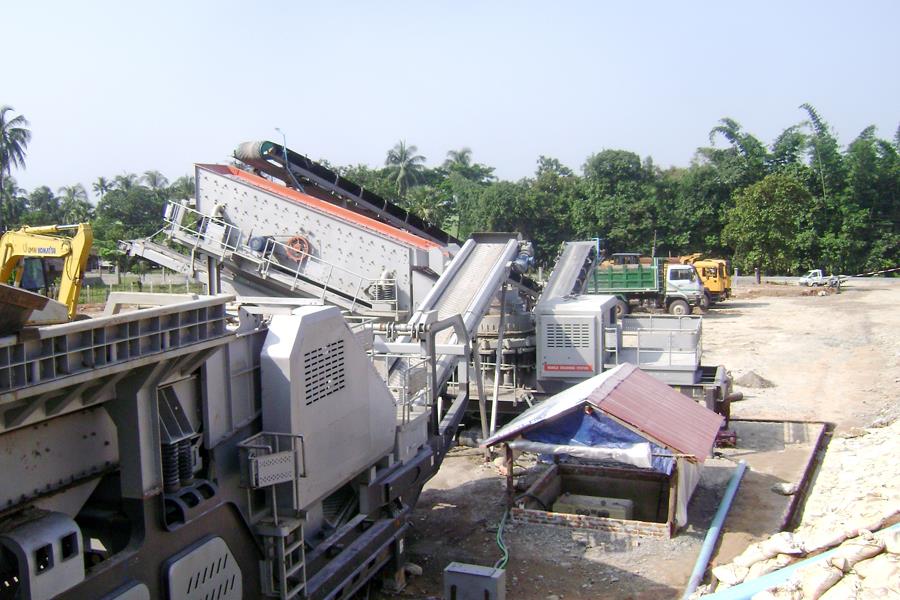
Advantages and Disadvantages of Semi-Mobile Crushing Stations
Currently, due to the rapid development of infrastructure and construction industries, the demand for sand and gravel aggregates has surged dramatically. However, the supply of natural sand resources remains insufficient, leading to an imbalance between supply and demand. Against this backdrop, mining crushers can resolve the contradiction in the supply-demand imbalance of sand and gravel aggregates, effectively addressing the challenge of construction sand supply. Mining crushers are categorized based on the degree of fixation between the crushing equipment and the foundation: mobile, semi-mobile, semi-fixed, and fixed. Below is a brief overview of the advantages and disadvantages of semi-mobile crushing plants.
Semi-mobile crushing plants are positioned at suitable working levels within open-pit mines. As the working benches advance and expand, the crushing units are relocated as a whole (or in sections) using tracked transport vehicles or other towing equipment. The most distinctive feature of semi-mobile crushing plants is their lack of concrete foundation connection to the ground. Their service life ranges from several months to several years, with relocation typically taking no more than 48 hours. Beyond relocation time, a key distinction between semi-mobile and fully mobile crushing plants lies in equipment placement. Semi-mobile plants are typically positioned on the working face of the mining area, within a material transport distance of less than 3 km. Relocation occurs only when the mining bench extends beyond the reasonable transport distance and climbing height for trucks.
Advantages:
Combines the mobility advantage while overcoming the drawbacks of semi-fixed stations and lengthy relocation times. Eliminates the need for large foundations; allows flexible placement on working or non-working benches. Relatively compact and lightweight equipment facilitates disassembly, hoisting, and relocation for enhanced flexibility and efficiency. Frequent relocations with short individual operation times ensure continuous mine production.
Disadvantages:
1. Requires tractor-trailer towing, resulting in lower automation.
2. Its capacity is equivalent to a small-scale fixed rock processing line. For users with high production demands, such as large-scale operations, it cannot meet standard capacity requirements.
So, which is better: mobile crushing stations, semi-mobile crushing stations, semi-fixed crushing stations, or fixed crushing stations? Mobile crushing stations reduce operational space and time requirements compared to fixed stations, offering greater adaptability for site relocation. Fixed crushing stations are more widely used for aggregate production and offer higher output. The specific choice depends on the user's actual circumstances.
We welcome you to visit OCP Heavy Industry for an on-site tour of our facilities and crushers, and to consult on crusher selection. Our specialists will recommend the most suitable crusher based on your material properties and regional production characteristics! Click the website chat icon for immediate free consultation—available 24/7.
-
-
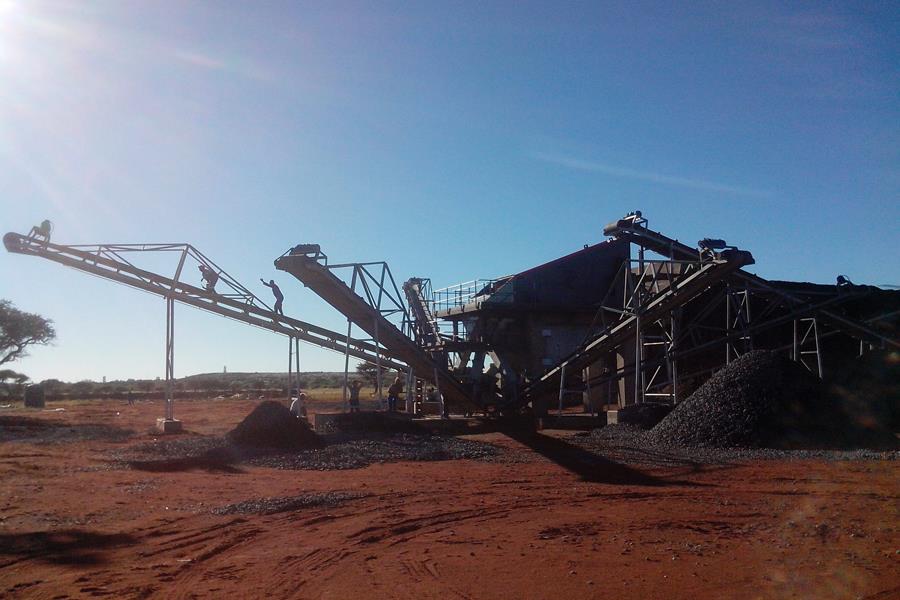
Advantages and Disadvantages of Semi-Fixed Crushing Stations
-
-
Working Principle and Chassis Design of Mobile Crushing Stations
-
Pebble Sand Making Machines Significantly Boost Pebble Production Efficiency