Ten Key Comparisons Between Single-Cylinder and Multi-Cylinder Hydraulic Cone Crushers
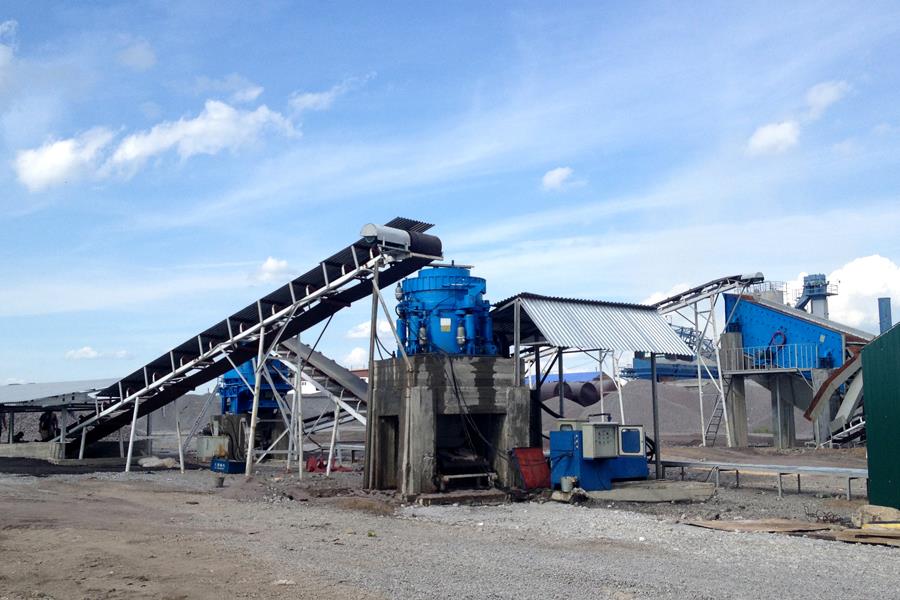
Hydraulic cone crushers are commonly employed in the secondary crushing stage of sand and gravel production lines. They are generally categorized into single-cylinder and multi-cylinder hydraulic cone crushers. Both types have earned consistent praise from users for their high productivity, advanced automation, substantial output, large crushing ratio, excellent particle shape, low energy consumption, and straightforward operation and maintenance. Although both types can handle medium crushing, the distinction between “single-cylinder” and “multi-cylinder” models indicates fundamental differences. Today, we provide a comprehensive, detailed analysis of the key distinctions between these two variants.
1. Comparison of Discharge Opening Adjustment Mechanisms
Single-Cylinder: During normal operation, the oil pump injects or drains oil into the main shaft cylinder, causing the main shaft to move up or down (vertical float of the main shaft) to adjust the discharge opening size. This adjustment method may make it difficult to lock the discharge opening when crushing hard ore.
Multi-Cylinder: Hydraulic actuators or motors adjust the cap, driving the adjustment ring to rotate within the support sleeve (lifting the fixed cone screw up or down) to achieve adjustment. This method facilitates easier locking of the discharge opening.
2. Comparison of Overload Protection
Single-Cylinder Overload and Chamber Clearing: During overload, hydraulic oil is injected into the accumulator, causing the main shaft to drop. After overload, the accumulator returns the oil pressure, restoring normal operation. Chamber clearing also utilizes the hydraulic pump.
Multi-Cylinder Overload Protection: When an unbreakable foreign object passes through the crushing chamber or the machine overloads for any reason, the hydraulic safety system activates. The discharge opening enlarges, expelling the foreign object from the crushing chamber. If the object becomes stuck in the discharge opening, the cavity clearing system can be used to further enlarge the opening and remove the object. Under hydraulic system control, the discharge opening automatically resets, restoring the machine to normal operation.
3. Comparison of Lubrication Systems
Single-Cylinder: Oil is supplied through two inlet ports. One enters from the lower end of the main shaft, lubricating the spherical bearings, spherical bushings, frame bushings, main shaft bushings, and subsequently the large and small bevel gears. The other enters from the transmission shaft end, lubricating the transmission shaft bushings. Both oil streams are discharged through the same outlet port.
Multi-Cylinder: One line enters the machine through a lower oil port, reaches the middle of the main shaft, and then branches into three sub-paths: lubricating the inner and outer surfaces of the eccentric sleeve, the spherical bearing via the central oil port on the main shaft, and the large and small bevel gears through ducts. Another line enters through a port on the drive shaft bracket to lubricate the drive bearing, with return oil flowing back through the return oil port beneath the small bevel gear and the return oil port on the dust cover.
4. Comparison of Crushing Force Components
Single-Cylinder: Similar to spring cone crushers, the single-cylinder hydraulic cone crusher integrates the main shaft and moving cone assembly, supported by a bowl-shaped bearing. Thus, the main shaft and moving cone are effectively supported by the base, with the eccentric sleeve driving the main shaft to generate crushing force.
Multi-Cylinder: The main shaft of a multi-cylinder hydraulic cone crusher is thick and short, allowing for a large diameter design. It is directly mounted on the frame (rather than within the eccentric sleeve) and supported by the frame itself, providing higher load-bearing capacity. The eccentric sleeve directly drives the moving cone to generate crushing force.
The differing mechanical structures of single-cylinder and multi-cylinder cone crushers result in distinct frame stress patterns during mineral crushing. The former subjects the frame to tensile stress, while the latter imposes reduced tensile stress. Consequently, multi-cylinder cone crushers exhibit superior frame design characteristics.
5. Comparison of Wear Parts
Single-Cylinder: Non-standard wear parts: Cone liner, oil seal, bowl liner, shaft sleeve, thrust cap, shear ring, crushing wall, dust seal, upper/lower friction discs, oil seal ring, frame bushing, middle friction ring, eccentric bushing.
Multi-cylinder: Standard wear parts: V-belts, skeleton oil seals, sealing rings, dust seals; Non-standard wear parts: Small bevel gears, shaft sleeves, protective plates, eccentric sleeve liners, large bevel gears, upper friction discs, spherical bushings, crushing cones, cone heads, floating bushings, sealing rings, grinding bowls, ribbed protective plates.
6. Comparison of Counterweights
Single-cylinder: Heavy + Thick; Multi-cylinder: Heavy + Thin.
This is because, for single-cylinder cone crushers, when the main shaft and moving cone move toward the tight opening side, the thicker side of the eccentric sleeve is positioned at the wide opening side. At this point, the entire moving cone's center of gravity shifts toward the tight opening side. Therefore, counterweights must be added to the thicker side of the eccentric sleeve to balance the entire moving cone assembly. Moreover, as the main shaft and moving cone advance toward the tight opening, material accumulates at the wide opening, creating resistance against the cone's movement toward the wide side. The counterweight facilitates smoother cone movement toward the wide opening. In contrast, the main shaft of a multi-cylinder hydraulic cone crusher remains stationary, so counterweights only need to account for the eccentric sleeve.
7. Comparison of Feeding Methods
Generally, both single-cylinder and multi-cylinder hydraulic cone crushers can operate at full feed capacity. The latter's high load-bearing capacity easily accommodates full feeding while utilizing the layer compression principle. Within the crushing chamber, materials undergo simultaneous crushing and mutual compression, achieving both fragmentation and shaping. Consequently, the output particle shape is exceptionally uniform. However, note that full feed merely means the crushing chamber is filled with material. At this point, crushing efficiency is maintained while ensuring uniform wear.
8. Comparison of Crushing Performance
Multi-cylinder hydraulic cone crushers exhibit higher fine particle content at the discharge opening during fine crushing, delivering superior fine crushing results and effective layer compression. Single-cylinder hydraulic cone crushers excel in medium crushing with greater throughput capacity.
9. Comparison of Actual Production Capacity
When crushing soft or weathered ores, the single-cylinder hydraulic cone crusher's high throughput advantage is prominent. Conversely, when processing medium-hard or high-hardness ores, the multi-cylinder hydraulic cone crusher performs more outstandingly. For fine crushing of medium-hard or harder ores, under identical specifications, the multi-cylinder model produces more qualified output. Generally, the harder the ore, the greater the performance difference between the two types.
10. Comparison of Operation and Maintenance
Single-cylinder crushers feature simple structure and reliable performance: a single hydraulic cylinder ensures compact design, low failure rate, and reduced production costs (simpler mechanical systems correlate with lower failure rates, higher reliability, and more stable operation).
Multi-cylinder crushers feature top or side access for quick maintenance: All components can be disassembled and serviced from the top or side. The moving cone and top cone are easily removable without dismantling the frame or tightening bolts, facilitating routine replacements.
If you are interested in single-cylinder hydraulic cone crushers or multi-cylinder hydraulic cone crushers, please click on the website customer service for a free consultation. Available 24/7 online.
-
Why is the hydraulic cone crusher more recommended for crushing sand and gravel
-
What are the common types of crushers? Which manufacturers are reliable?
-
What crushing equipment is suitable for construction sand? How much investment is required?
-
-