Structure of the Simple Swing Jaw Crusher
(1) General Structure
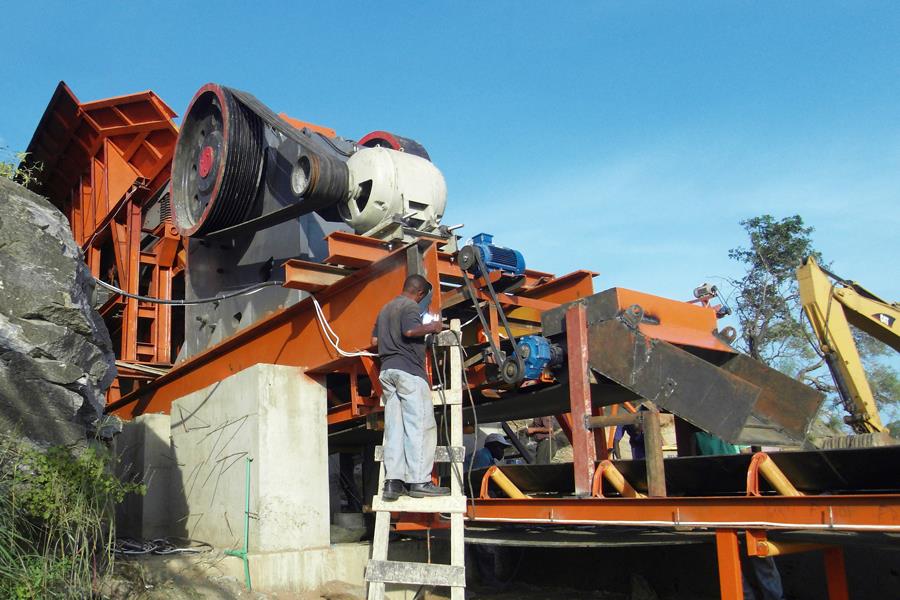
Both the fixed jaw and moving jaw are equipped with liners, which have teeth to aid in crushing the material. The function of the liners is to prevent wear on the fixed jaw and moving jaw. The shaft is supported at both ends by bearings, with connecting rods mounted on them. The connecting rod heads and shafts are manufactured separately. The motor drives the pulley and eccentric shaft via a V-belt. In the groove below the connecting rod, there is a thrust plate support, with the front thrust plate and rear thrust plate respectively supported on the support. The eccentric shaft has a pulley installed at one end and a flywheel at the other end. The side walls of the crushing chamber are fitted with manganese steel side liners secured by screws or wedges. The fixed jaw liners are secured with screws, and their lower ends are welded to steel plates on the frame, while their upper ends are clamped by pressure plates to prevent vertical movement. The movable jaw liners are supported below by the protruding surface on the lower part of the movable jaw and clamped above by wedge irons.
Between the rear thrust plate and the rear support, there is a set of shims used to adjust the discharge opening width. Increasing the shim thickness causes the thrust plate and moving jaw to shift to the left, reducing the discharge opening. Conversely, reducing the shim thickness increases the discharge opening.
To prevent damage to the crusher caused by overload operation, the rear thrust plate is designed as the weakest link during part design calculations. When overloaded, it breaks first to protect the bearings and other machine components from damage. Typically, the rear thrust plate is made of cast iron with holes or slots drilled in the middle to reduce its cross-sectional dimensions, causing it to break first during overload conditions. The drawback of this safety device is that accident handling is more complex and downtime is longer.
(2) Hydraulic structure
In this type of simple swing crusher, both the discharge opening and the safety device are composed of a hydraulic system. The hydraulic discharge opening adjustment device uses a hydraulic cylinder and piston to adjust the width of the discharge opening, with oil supplied to the hydraulic cylinder via a manual or electric oil pump. After the piston pushes the thrust plate to the required position, a spacer plate is inserted. During machine operation, the spacer plate bears the pressure from the rear thrust plate, while the piston and hydraulic cylinder no longer bear any pressure.
This type of crusher is equipped with a hydraulic safety device and a hydraulic linkage device. The linkage features a hydraulic cylinder and piston, with the cylinder connected to the upper part of the linkage (linkage head) and the piston connected to the lower part of the linkage (thrust plate mount). During normal operation, the cylinder is filled with pressurised oil, and the piston and cylinder function as an integral part of the linkage. When non-crushable objects enter the crushing chamber, the tensile force acting on the linkage increases, causing the oil pressure in the lower oil chamber of the cylinder to rise. If the oil pressure exceeds the pressure specified by the high-pressure relief valve in the combination valve, the pressure oil is discharged through the high-pressure relief valve, causing the piston and thrust plate to stop moving, and the moving jaw to cease swinging, thereby serving as a safety mechanism.
We are a mining machinery company integrating R&D, production, sales, and service. Our main products include jaw crushers, cone crushers, impact crushers, sand makers, mobile crushing plants, ball mills, and production line supporting equipment. We welcome all customers to visit our factory for on-site inspections. Click on the website customer service to consult for free immediately, available 24/7 online.