
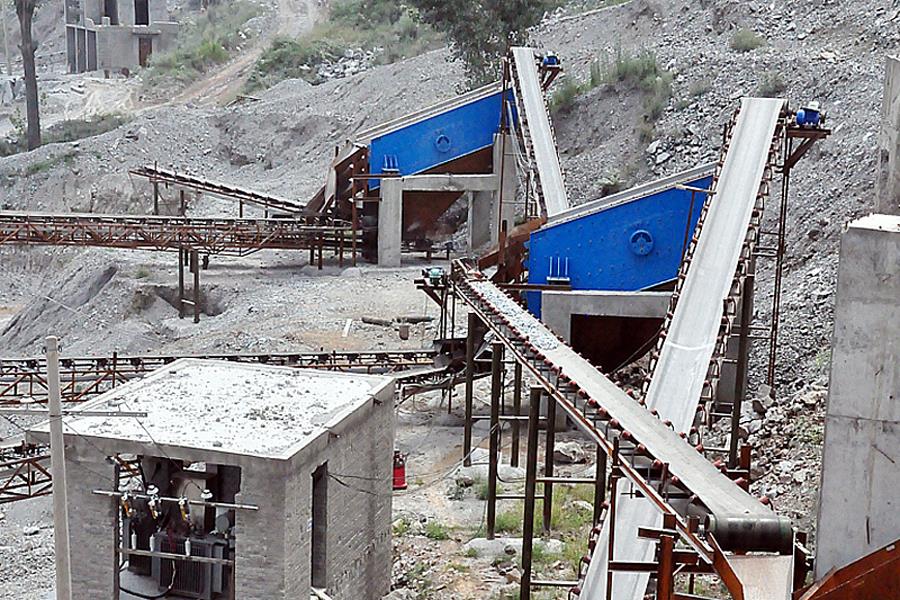
Differences Between Jaw Crushers and Impact Crushers
What are the differences between jaw crushers and impact crushers? The distinctions between jaw crushers and impact crushers lie in the following aspects:
I. Application:
Jaw crushers are typically used for primary crushing, breaking large materials into sizes suitable for secondary crushers like cone crushers, impact crushers, or double-roll crushers. Secondary crushers generally handle smaller feed sizes. If feed material is too large, a jaw crusher must be used as the primary crusher. Impact crushers are commonly used for materials like marble and granite. However, extremely hard materials are unsuitable for impact crushers, as they cause excessive wear on vulnerable components.
II. Scope of Application:
Jaw crushers, abbreviated as jaw crushers, are primarily used for medium-sized crushing of various ores and large materials. They can crush materials with compressive strengths not exceeding 320 MPa and are categorized into primary and secondary crushers. This series offers a complete range of specifications, with feed sizes ranging from 125 mm to 750 mm, making it an ideal primary crushing equipment.
Impact crushers (impact breakers) produce cubic-shaped finished products free of tension and cracks, with excellent particle shape. They can crush coarse, medium, and fine materials (such as granite, limestone, concrete) with feed sizes not exceeding 500mm and compressive strengths not exceeding 50MPa. The discharge particle size is adjustable, offering diverse crushing specifications.
III. Working Principle:
During operation, the motor drives the belt and pulley, causing the eccentric shaft to move the movable jaw up and down. When the movable jaw rises, the angle between the toggle plate and the movable jaw increases, pushing the movable jaw plate toward the fixed jaw plate. Simultaneously, the material is crushed or split, achieving the crushing objective. As the movable jaw descends, the angle between the toggle and movable jaw decreases. Under the force of tie rods and springs, the movable jaw plate moves away from the fixed jaw plate, allowing crushed material to discharge from the lower opening of the crushing chamber. Continuous motor rotation drives the movable jaw's periodic motion to crush and discharge material, enabling batch production.
During operation of the impact crusher, the rotor spins at high speed driven by the motor. When material enters the impact plate zone, it collides with the impact plates on the rotor for initial crushing. The material is then thrown onto the impact device for secondary crushing, bounces back from the impact liner plate to the impact plate zone for further crushing, and this process repeats. The material progresses through the first, second, and third impact chambers, undergoing repeated crushing from large to small sizes until it reaches the desired particle size and is discharged through the outlet.
IV. Performance Features:
The jaw crusher features: a deep crushing chamber with no dead zones, enhancing feed capacity and output; a high crushing ratio with uniform product particle size; a shim-type discharge adjustment mechanism that is reliable, convenient, and offers a wide adjustment range, increasing equipment flexibility; Simple structure, reliable operation, and low maintenance costs. Energy-efficient: 15%-30% energy savings per unit, over double the energy efficiency for the entire system; Wide discharge opening adjustment range to meet diverse user requirements; Low noise and minimal dust generation.
Impact Crusher (Impact Breaker) Features: Large feed opening, high crushing chamber, capable of handling high-hardness materials and large block sizes with minimal stone powder output; The gap between impact plates and hammers can be easily adjusted to effectively control output particle size and ensure good particle shape; Compact structure, high machine rigidity, and rotor with large rotational inertia; High-chromium hammers provide impact resistance, wear resistance, and high impact force; Keyless connection facilitates maintenance, offering economic reliability; Comprehensive crushing capabilities, high productivity, low component wear, and high overall efficiency.
(Technical parameters and data mentioned herein may be updated with product upgrades. Click website customer service for the latest equipment specifications.)
OCP specializes in developing and manufacturing complete sets of equipment for crushing, screening, grinding, washing, feeding, conveying, environmental protection, dust removal, as well as steel, metallurgy, and steel slag processing and recycling. Our products are widely used in the crushing and processing of metals, non-metallic minerals, energy raw materials, and metallurgical waste residues within the steel and metallurgical sectors. Click website customer service for immediate free consultation, available 24/7.
-
-
How to Select Suitable Crushing Equipment Based on Ore Raw Materials
-
What are the differences between impact crushers and jaw crushers
-
-
How Can China is Mining Machinery Equipment Rise in the International Market