What factors affect the output of a cone crusher
What factors affect the output of a cone crusher? A cone crusher is a type of crushing machinery used in the metallurgy, construction, road construction, chemical, and silicate industries for crushing raw materials. Depending on the crushing principle and product particle size, it is further divided into many models. Crushers are widely used in various industries such as mining, metallurgy, building materials, highways, railways, water conservancy, and chemical industries. Cone crushers feature a high crushing ratio, high efficiency, low energy consumption, and uniform product particle size, making them suitable for medium and fine crushing of various minerals and rocks.
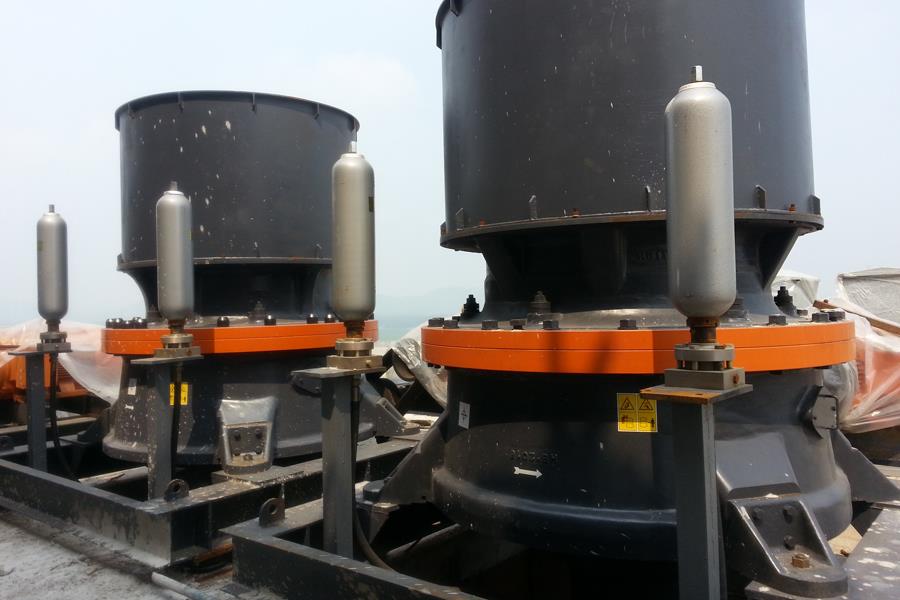
During the operation of the cone crusher, the motor drives the eccentric sleeve to rotate through the transmission mechanism. The moving cone performs rotational swinging under the force of the eccentric shaft sleeve. The section where the moving cone approaches the stationary cone forms the crushing chamber, where the material is crushed through multiple squeezing and impact actions by the moving and stationary cones. When the moving cone leaves this section, the crushed material that has reached the required particle size falls under its own weight and is discharged from the bottom of the cone. The production capacity of the cone crusher is determined by three factors: the number of oscillations of the crushing cone, the length of the parallel discharge zone, and the size of the meshing angle.
What factors affect the production capacity of a cone crusher?
1. The number of oscillations of the crushing cone
The number of oscillations of the crushing cone is one of the key factors affecting the crusher's production capacity.
Due to the limitations of the crushing chamber's rake angle and parallel discharge zone, the crushed ore primarily relies on gravity and vibration to be discharged along the cone's inclined surface. When the main shaft's rotation speed increases, the ore is easier to discharge; however, an excessively high rotation speed can hinder discharge and may cause the machine to run out of control, rendering it unable to operate. Therefore, the oscillation frequency of the crushing wall has a certain constraining effect on production capacity.
2. Length of the parallel crushing zone
The parallel crushing zone is the area that ensures uniform particle size in a cone crusher. Crushing capacity is related to the thickness of the material layer in the parallel zone, which is directly related to the size of the discharge opening. Increasing the length of the parallel zone facilitates particle size control but reduces discharge capacity; reducing the length of the parallel zone facilitates discharge but makes it difficult to ensure consistent particle size.
Additionally, since the production rate of a crusher is primarily influenced by factors such as the properties of the ore, machine performance, specifications, and operating conditions, as well as its configuration within the production process, changing operating conditions (adjusting the discharge opening size of the cone crusher) will alter the crusher's production rate under otherwise constant conditions.
3. Size of the meshing angle
The angle between the concave liner and the crushing wall of the cone crusher is called the meshing angle. The meshing angle is generally set at 22–23°, with a maximum of 27°.
The shape of the crushing chamber, from the feed opening to the discharge opening, is influenced by the meshing angle and is also limited by the height of the crusher, resulting in relative changes in the chamber volume, which has a certain impact on crushing efficiency.
Theoretically, if the rake angle is too large, the ore is prone to slipping within the crushing chamber, reducing production capacity while increasing liner wear and energy consumption; if the rake angle is too small, it will result in a smaller crushing chamber, reducing the amount of ore it can accommodate, affecting output, while also increasing equipment manufacturing costs and machine height.
If you are interested in cone crushers or related equipment, you can click on the website customer service to consult for free immediately, available 24/7 online.
-
-
Common Features of Tyre-Mounted Mobile Crushing Plants and Track-Mounted Mobile Crushing Plants
-

Differences Between Tyre-Mounted Mobile Crushing Plants and Track-Mounted Mobile Crushing Plants
-
Working Principle and Structural Composition of the Vortex High-Impact Crusher
-