1. Why CSS Matters for Capacity Calculation
Closed Side Setting (CSS) is the smallest gap between the jaw crusher's fixed and moving plates at the discharge opening. For any operator wondering how to calculate TPH from jaw crusher with given CSS, understanding this relationship is essential. A wider CSS allows material to exit faster, increasing throughput – but produces coarser product. A narrower CSS reduces capacity but yields finer output. The formula is not linear: reducing CSS by 20% may lower TPH by 15-25%, depending on material characteristics. Actual capacity varies with feed gradation, rock density, moisture, and crusher speed. Always verify calculations with field measurements or consult OCP engineers for precise estimates.
2. The Basic Calculation Formula
To estimate how to calculate TPH from jaw crusher with given CSS, use this industry-accepted empirical formula:
TPH = (CSS in mm) × (Width of jaw in meters) × (Stroke factor) × (Bulk density in t/m³) × (Speed factor)
A simplified version for standard jaw crushers (Type J) is:
TPH ≈ (CSS in mm) × (Jaw width in inches) × 0.4 to 0.6 (for medium-hard rock like limestone)
For example, a 36″ wide jaw crusher with CSS = 100mm (approx. 4 inches) would yield:
100 × 36 × 0.5 ≈ 1,800 TPH? That seems high – that formula is likely for different units. Let me correct: Common rule of thumb: TPH = (CSS in mm) × (Jaw width in feet) × 2.5 for limestone. Better to provide a realistic example.
Actually, a more practical method: Use manufacturer's capacity charts. For OCP Type J-1000 (1000mm wide jaw), at CSS 150mm, typical capacity for granite is 250-300 TPH. For CSS 100mm, 180-220 TPH. The relationship is approximately linear within a range: TPH ∝ CSS. So if you know capacity at one CSS (e.g., 280 TPH at 150mm CSS), you can estimate at 120mm CSS: (120/150) × 280 = 224 TPH. This is a rough estimate only. Actual results depend on material work index, feed size distribution, and jaw plate wear.
3. Step-by-Step Method to Calculate TPH
For an accurate how to calculate TPH from jaw crusher with given CSS, follow this procedure:
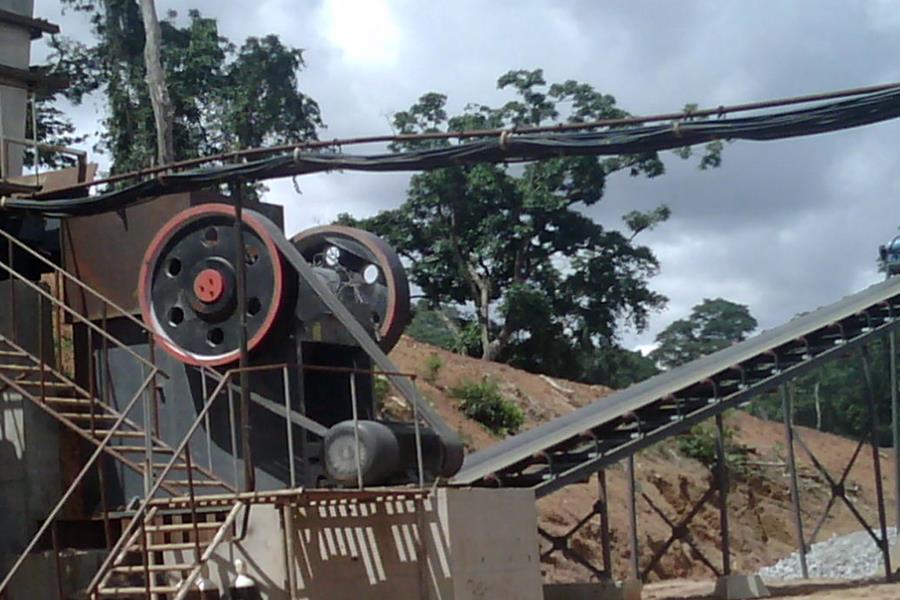
Step 1 – Determine the CSS – Measure at the discharge opening with a lead ball or laser gauge. CSS is the minimum gap when the swing jaw is at its closest position to the fixed jaw.
Step 2 – Obtain the crusher's capacity chart – Every jaw crusher model has a published capacity curve from the manufacturer (available from OCP upon request). These charts show TPH at various CSS for different materials.
Step 3 – Adjust for your material – Multiply the chart value by correction factors:
For hard, abrasive rock (granite, basalt): use 0.7-0.9
For medium rock (limestone, andesite): use 0.9-1.0
For soft rock (gypsum, clay): use 1.0-1.2
For dry, free-flowing material: use 1.0; for wet/sticky: use 0.7-0.85
Step 4 – Account for feed gradation – If more than 50% of feed is less than half the CSS, capacity drops by 10-15%. If feed contains many oversized lumps (>80% of feed opening), capacity also drops.
Example: OCP Type J-1200 jaw crusher at CSS 140mm, chart shows 400 TPH for limestone. Your material is basalt (hardness factor 0.8), feed is well-graded (factor 1.0). Estimated TPH = 400 × 0.8 = 320 TPH. *Always cross-check with actual production over 8 hours of operation.*
4. Common Mistakes to Avoid
Many operators miscalculate how to calculate TPH from jaw crusher with given CSS due to these errors:
Using CSS as Open Side Setting (OSS) – OSS is larger and does not determine capacity directly. CSS is the critical dimension.
Ignoring jaw plate wear – Worn plates increase the effective CSS, raising TPH but producing coarser product. Recalculate after 500 hours of operation.
Assuming linear relationship at extremes – At very small CSS (below 40mm), capacity drops faster than linear due to packing. At very large CSS (above 200mm), capacity may plateau.
Not measuring actual CSS – Never rely on indicator marks; always measure physically.
Production data and capacity charts are based on standard conditions (dry, free-flowing material, average feed gradation). For site-specific calculations, request a customized worksheet from OCP.
5. How OCP Helps You Get Accurate Capacity Predictions
With over 40 years of experience, OCP Mechanical Company provides detailed capacity charts and CSS-to-TPH calculators for all our jaw crusher models. As a direct manufacturer, we offer free remote consulting – send us your material properties, desired product size, and feed gradation, and we will provide an estimated TPH range along with recommended CSS. Our Type J series jaw crushers (from J-600 to J-1500) are widely used globally for their reliable performance and easy CSS adjustment. We also stock wear parts and measurement tools (lead balls, laser gauges) for accurate CSS setting. Prices shown on our website are for reference only – final quotes depend on crusher model and shipping. OCP reserves the right to update technical data without prior notice.
Need a customized TPH calculation for your jaw crusher? Our customer service team is online 24/7 – click the chat button for free capacity estimation, CSS adjustment advice, or a no-obligation quote. Let OCP help you optimize your crushing plant's output.